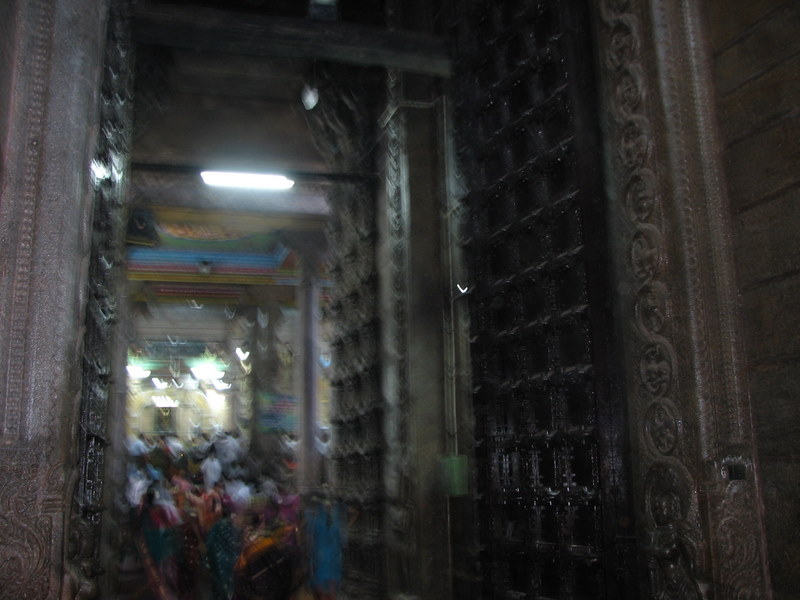
1/9/11 : We were in Madurai on Ganesh Chathurthi Day.We reached in the evening & checked into TTDC Hotels near Arasaradi - we were given a nice double deluxe A/c suite with an annexe @ Rs.1250/-(which included a Sr,Citizens discount of Rs.350/-). After getting refreshed we went straightaway to the Madurai Meenakshi Temple:( Please log onto www.sankriti.blogspot.com/2008/10/madurai-meenakshi-temple.html for the earlier post of 2008).
In the outer prakaram of the Meenakshi sanctum we captured photographs of the King Thirumalai Naicker and his consorts who were associated significantly with the construction of the temple during the 17th Century.

We noticed that the Lotus Pond was completely dry - but nevertheless looked so majestic in the fading light of the evening.

The Vibhuti Pillayar continued to draw generous crowds - as per tradition, devotees picked up Vibhuti from the trough and showered the Pillayar with it.


Since the day was Ganesh Chathurthi, a day of celebration for Lord Ganesha we noticed that the Mukkuruni Pillayar was adorned with Silver Kavacham (covering) apart from other adornments including plenty of flowers and garlands - it was truly magnificent to behold.

(He got his name because a gigantic modhakam is given as an offering to him on the Vinaayakar Chathurthi Festival.This modakam is made with 3 kurunis of rice.A kuruni is a type of measure. It is equivalent to 4 padis. Mukkuruni is 3 X 4 = 12 padis of rice.12 measures of rice are taken and cleaned well with water. Then it is soaked. It is then pounded in a 'ural' - mortar. The flour is mixed with gram, coconut, cane sugar, salt, cardamom, etc. It is then moulded and wrapped in a cloth and made into a bundle. It is then steamed in a giant 'kopparai' - steamer which was made especially for this purpose. When appropriately cooked, it becomes a gigantic 'Modakam'.)
We paused for a few minutes at the Rajatha Sabhai - to admire the lareg dancing figure of Nataraja in Silver Kavacham. At the sanctum sanctorum of Sundareswarar we revisited the Astha Dik Gaja mandapam - a remarkable sight of eight elephants carved in stone around the sanctum - 2 elephants in each direction. Outside the sanctum is the Kambathadi Mandapam - which has the Nandi, the Dwaja sthambam and an array of magnificent stone sculptures.
At the Kili Mandapam we found devotees rubbing sandalwood on a large cylindrical stone to produce sandal paste - an old tradition that has been revived at this temple.


We also noticed magnificent sculptures of the Mahabharatha heroes - the Pancha Pandavas ie.Dharma, Bhima, Arjuna, Nakula & Sahadeva.


We found nice beautiful and bright frescoes depicting temple legends on the walls adjacent to the Lotus pond.

We also visited another Mandapam near Adi Veethi which had some amazing sculptures - see pics below:


 we were served piping hot idli's followed by delicious onion uthappam's. The cafe also served Jil Jil (cool cool) Jigarthadna - a special beverage that has its origins in Madurai. In Hindi it means Cold Heart. Please log onto website for details and recipe for jigarthanda: http://sukanya-keralaiyer.blogspot.com/2007/05/jigar-thanda.html

 Each of the eight saktis ( representing female consorts of different Gods) is elegantly and skilfully sculpted.
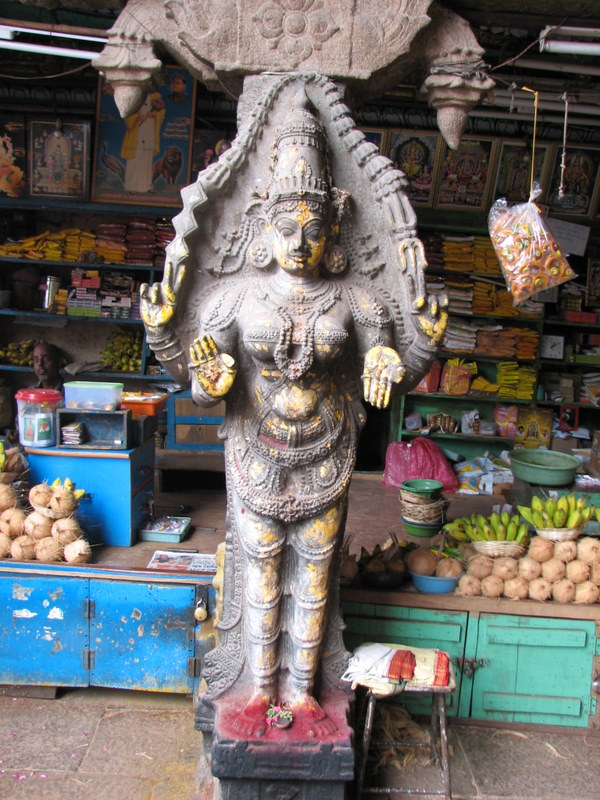 2.Rowthri
 3.Vaishnavi
 4.Mahalakshmi
 5.Manonmani
 6.Maheswari
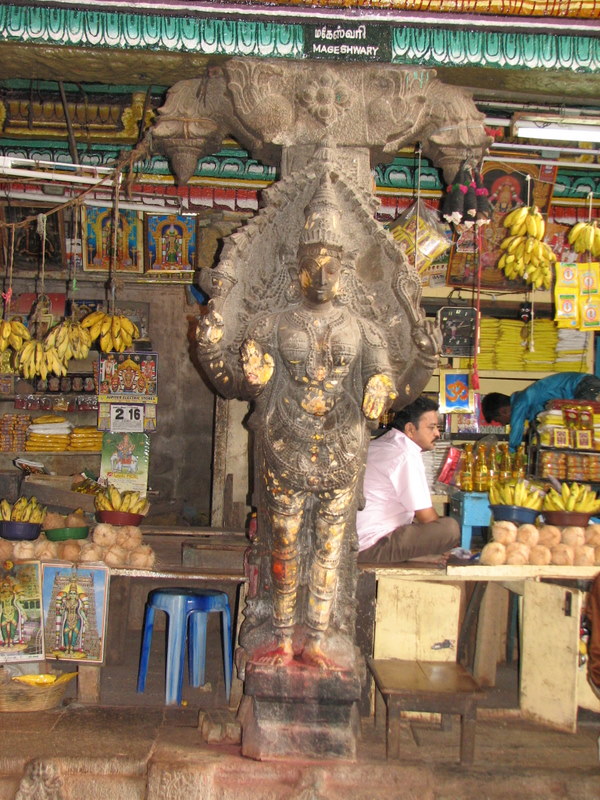 7.Shyamala & Yagyaroopini
 9.Other Sculptures:

 2.Silver elephant on palanquin
 3.The Temple Elephant-colorfully attired
 4.Goddess Meenakshi & Lord Sunderaswarar in Golden Palanquin
 5.Goddess Meenakshi - magnificently attired
 6.Lord Muruga atop his favorite vehicle - peacock
 7.Lord Ganesha atop his vehicle - a rat
 8.The procession begins: Led by the temple elephant followed by other vehicles.

 We noticed that the Lotus Pond was completely dry - but nevertheless looked so majestic in the fading light of the evening.
  The Vibhuti Pillayar continued to draw generous crowds - as per tradition, devotees picked up Vibhuti from the trough and showered the Pillayar with it.
 Since the day was Ganesh Chathurthi, a day of celebration for Lord Ganesha we noticed that the Mukkuruni Pillayar was adorned with Silver Kavacham (covering) apart from other adornments including plenty of flowers and garlands - it was truly magnificent to behold.
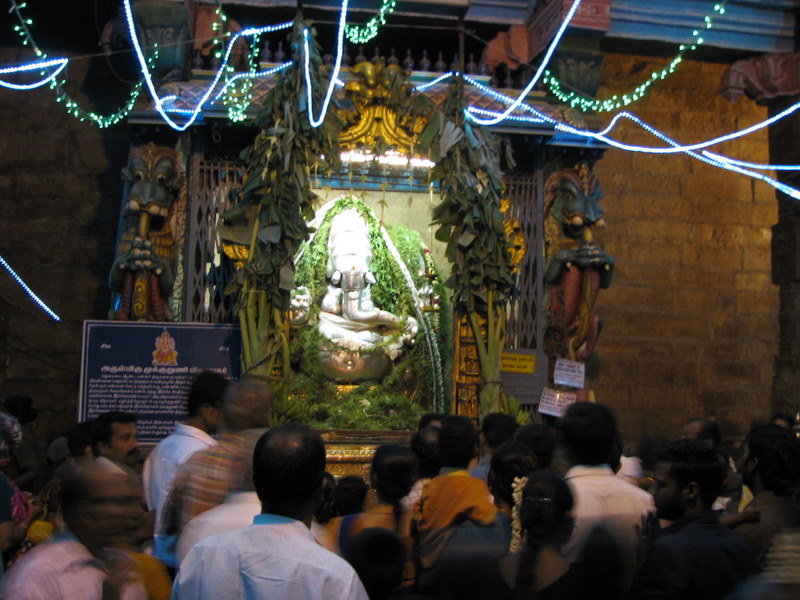 (He got his name because a gigantic modhakam is given as an offering to him on the Vinaayakar Chathurthi Festival.This modakam is made with 3 kurunis of rice.A kuruni is a type of measure. It is equivalent to 4 padis. Mukkuruni is 3 X 4 = 12 padis of rice.12 measures of rice are taken and cleaned well with water. Then it is soaked. It is then pounded in a 'ural' - mortar. The flour is mixed with gram, coconut, cane sugar, salt, cardamom, etc. It is then moulded and wrapped in a cloth and made into a bundle. It is then steamed in a giant 'kopparai' - steamer which was made especially for this purpose. When appropriately cooked, it becomes a gigantic 'Modakam'.)
 We also noticed magnificent sculptures of the Mahabharatha heroes - the Pancha Pandavas ie.Dharma, Bhima, Arjuna, Nakula & Sahadeva.


 We found nice beautiful and bright frescoes depicting temple legends on the walls adjacent to the Lotus pond.
 We also visited another Mandapam near Adi Veethi which had some amazing sculptures - see pics below: