Thursday, September 20, 2012

Prince Krishna Deva Raya, Hampi tour Day 1

After lunch we were on a mission to meet a person who claimed to be the descendent of Krishna Deva Raya. He has the same name too and is a B.Tech in Mechanical Engineering from Davangere. He is also a  post graduate from USA and was employed in Washington for 7 years. He was compelled to return to India to take over the family business (iron ore mining) when his father expired. We had to cross the Tungabhadra river by boat to reach his village Anegundi. To reach this village by road we would have had to take a 63 Km detour !
Crossing the Tungabhadra by boat
Renovation of the palace using traditional lime mortar instead of steel & cement
The young & dapper "Prince" explaining traditional construction technique
Tracing his royal lineage, the extremely soft spoken descendant says, “I actually belong to the Aravidu dynasty while Krisha Deva Raya is from the Tuluva dynasty. I am not a direct descendant in that sense. My lineage can be traced back to the king’s daughter’s husband, Aliya Rama Raya’s family.” Why then does he carry the name of the great king just as he does, the royal demeanor in his posture, gait and his visage? “Our tradition has it that every third generation is given the same name. I might be the fourth or the fifth Krishna Deva Raya  in my family so far,” he gently smiles.His humility and good natured demeanor was striking. “We aim to restore the house in Anegundi, educate our village about its ancient history and also get the old big structures retained in all its glory.”
The young prince has his captive audience enthralled
Group members listening with rapt attention
Visit to the lime mortar manufacturing bay.
Grinder for crushing limestone - this will be pulled by bullocks
Mixing of lime with water & sand to make lime mortar
Sand & Sieve

Wednesday, September 19, 2012

Lunch at Mango Tree,Hampi

Day 1: After the visit to Virupaksha Templa and the Hemakuta temples cluster our next stop was for lunch at Mango Tree restaurant in Hampi. The approach to the place is through a lovely banana plantation.This is a mud house with a rural ethnic theme and set in idyllic surrounding  on the banks of the Tungabhadra river with a spectacular view. To eat you need to sit cross legged on the floor on mats and the food is served on a low table.The ambiance is amazing and awesome. There is a huge mango tree around which the eatery is constructed. The food is simple and is served on banana leaves in steel plates.The pictures below tell  their own story:
Banana Plantataion
Young bananas emerging from the flower
Entrance to Mango Tree
Tourists having lunch on the banks of the Tungabhadra river
Our group having lunch
The lady preparing food in the kitchen
Domesticated Geese
The Tungabhadra in full flow

Monday, September 17, 2012

Hemakuta Temples, Hampi

Steps leading up to the Hemakuta hills
To the South of the Virupaksha Temple is Hemakuta Hill which contains a cluster of temples mostly ruins. You climb a small flight of stairs to reach the entrance of this temples cluster. Some of these temples with pyramid shaped roofs gives the impression of Jain Temples. In fact most of them are Shiva temples.The view from the top of the hill is breathtaking. A number of temples located on the hills are made in what is called the Trikutachala style. The largest and the most elaborate ones are located on the northern slop of the hill facing the Virupaksha Temple campus. These are in fact one of the oldest clusters of temples in Hampi, much older than the empire itself. The whole area looks more like a gigantic sheet of rock with undulation. 

Entrance Mandapam to the Hemakuta hills temples cluster
 
Virupaksha Temple as seen from the Hemakuta hills
Boulder formations
Siva Temples with pyramidal structure - above & below
 Further up and a bit south you can spot a pond in the courtyard of a shrine. This shrine called the Mula  Virupaksha temple and is older than the grand Virupaksha temple. The front hall of this whitewashed shrine spots a series of cubical pillars of pre-Vijayanagara style. Interestingly, the porch faces the water body and the steps from the porch lands into the water. This is one of the few shrines in this are that are under active worship.  This is one of the finest spots to witness a Hampi sunrise/sunset.Alas we visited during noon time and hence could witness neither sunrise nor sunset :(  The whole of Hemakuta Hill area is encircled with an ancient fortification. Though broken at many places, you can still make out the boundary line circling the hill.
Approaching the massive two storied southern gateway
Impressive boulder formation
The massive southern gateway
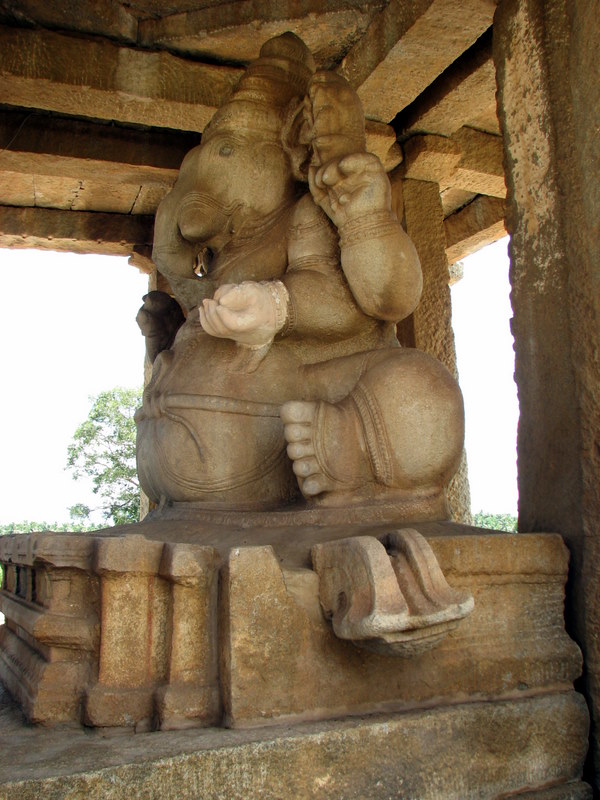
Descending downhill towards Sasivekalu Ganesh Mandapam
When you move further south, you practically get an aerial view of the Sasikavelu Ganesha monolith. At this point you can spot the monumental two storied southern gateway to the hilltop. This area too has a number of temples built in the pre-Vijayanagara  style architecture. Some of them even spots tall monolithic lamp posts in front of it. The exit through the gateway leads you to a short flight of steps carved on the rock surface. This flight of steps brings you to the Sasivekalu Ganesha statue. You can see below front,back and side views of the monolith statue.
See the Snake tied around Ganesha's tummy
Rear side photo of monolith: Does this give an impression of Ganesha sitting on his mother Parvathi's lap
 In Hindu mythology Lord Ganesha (also known as Ganapathi or Vinayaka) is is well known for his food habits. One day he ate so much that his tummy was about to burst. He caught hold of a snake and tied it around his tummy as a belt to save his tummy from bursting.On this statue you can see the snake carved around his tummy. This monolithic statue carved out of a huge boulder measures about 2.4 meters (8 feet). An open pavilion is build around the statue. According to inscriptions found nearby this pavilion was built by a trader from Chandragiri (in present day Andhra Pradesh)in 1506 AD.

Saturday, September 15, 2012

Virupaksha Temple, Hampi

 Hampi, now in ruins is the site of the ancient city of Vijayanagar, capital of the Vijayanagar empire (founded under the spiritual guidance of Vidyaranya of Sringeri  in early 14th century CE)) which brought about a renaissance of indigenous art and culture, as it defended the region against the  plundering armies from elsewhere.
 Much of Vijayanagar is now in ruins, as when the rulers were defeated at the hands of the invaders at the battle of Talikota in the 16th century, most of the marvelous structures and edifices were systematically destroyed.
 The Virupaksha or the Pampapathi temple is the main center of pilgrimage at Hampi. It is fully intact, and it incorporates some earlier structures.The temple's history is uninterrupted from about the 7th century. The Virupaksha-Pampa sanctuary existed well before the Vijayanagara capital was located here. Inscriptions referring to Shiva date back to the 9th and 10th centuries. This temple in its current form has three towers, the eastern tower rises to a formidable height of 160 feet and is nine tiered. It was was renovated in the sixteenth century by Krishnadevaraya
The Eastern Gopuram & entrance gopuram viewed from inside the temple
Lion at the temple entrance way
Temple entrance
A massive monolith
Exquisitely carved stone pillar
The temple bells
Latticed granite roofing
A Stone Stool
Our Group viewing the temple in inspired awe
Intricately carved massive stone urn
The temple elephant showering blessings on devotees
Carved pillars at the temple mandapam
Monumental multi tiered eastern Gopuram - beautifully embellished
Various views of the Eastern Gopuram - Above & Below

  Please also visit below posts:

Hampi Tour - Art & Architecture

Hampi Tour - Day 1

Rhesus Monkeys at Virupaksha Temple-Hampi

Fortune Tellers at Hampi

Sekhar Upanayanam