Sunday, November 3, 2019

A Memorable Trip to Mahabalipuram - Shore Temple

Shore Temple:This is one of the important landmarks on the Coramandel Coast in the Bay of Bengal. One of the oldest structural temples of South India, this was built during 700-728 AD during the reign of Pallava King Narasimhavarman II. The main temple faces east so that the suns rays shine directly on the main shrine housing thShiva Linga (Dharalinga). There is also a smaller shrine devoted to Lord Shiva (Kshatriyasimheswara). There are two pyramidal shikaras or pagodas atop these shrines. Between the two shrines is a small shrine devoted to a reclining Vishnu. The Shore Temple is a magnificently sculpted monument which proudly stands erect even after so many centuries enduring the ravages of time. There has been some erosion and certain amount of damage as a result of the 2004 tsunami. The Dharalinga is in Rajasimha style carved out of black basalt stone. It has sixteen faces with slight fluting to create a crown at the top. The 6 ft high linga is damaged at the top. Another distinctive feature is a Somaskanda panel of the inner walls facing Kshatriyasimheswara temple.
Kudos to ASI for the meticulous upkeep and maintenance of the shore temple campus which has been designated a World Heritage Site by UNESCO. The two panoramic photos at the end are testimony to this.  
Guhan and Buddha
 
Twin Pagodas of the Shore Temple
 
 
The 16 sided dharalingam slightly damaged at the top
Bas relief of Somaskandar
Small shrine of Boovarahamurthy
 
 
Durga astride the lion vahana - a small garbha griha in the lions chest.
Below are two scintillating panoramic views at the Temple site

Saturday, November 2, 2019

A Memorable Trip to Mahabalipuram - Krishna's Butterball

Our next rendezvous was Krishna's Butterball (adjacent to Arjuna's Penance) - a gigantic granite boulder poised and balanced precariously on a slope looking as if it would topple over anytime. This boulder weighing 250 tons and measuring 6m x 5m has been standing at the same spot for over 1200 years defying all laws of gravity.Sir Isaac Newton would certainly have been flummoxed & confounded. Attempts were made by Pallava King Narasimhavarman to move the rock but did not succeed. In 1908 Arthur Havelock the then governor of the city used seven elephants to pull the rock to safety but he too failed. It is said the Tamil Emperor Raja Raja Chozhan was highly inspired by this magnificent boulder.
This rock is surrounded by a well manicured spacious green lawn maintained meticulously by Archaelogical Society of India. It was past mid day and the sun was blazing and this took its toll on our energy levels.We took a brief respite on one of rocks to rejuvenate and regain some of the energy.
This 'Butterball' threw some amazing shadows and provided an appropriate back ground for some thrilling moments and an opportunity for amazing trick photography. Full credit to nephew Chandrasekhar to clicking all the marvelous photos posted here.
Tired and exhausted & resting for a while to regain some energy
Fully Rejuvenated

Thursday, October 31, 2019

A Memorable Trip to Mahabalipuram - Arjuna's Penance

Also known as The Descent of the Ganges. There are two legends associated with this relief which was created to celebrate the victory of Narasimhavarman I over Pulakesan II. This great victory also earned the king the epithet "Mamallan' or great warrior.The architectural creations at Mamallapuram adopted stone as the medium for sculpting in situ rock faces. The relief is created with great skill and imagination on two large boulders of pink granite in the open air. The natural cleft, a very large perpendicular fissure, is adroitly sculpted between the boulders and forms an integral part of the mythical narratives carved on the entire rock face. A water tank was once located at the top of the rock denoting the Ganges river. It cascaded over the cleft and the relief to give an impression that the water was descending from Shiva's head.The sculptures carved in the natural fissure that divides the cliff not only depicts the cosmic event of Ganga descending to earth, but also depicts scores of gods, goddesses and mythical figures of Kinnaras, Gandharvas, Apsaras, Ganas & Nagas as also many wild and domestic animals all admiringly watching the great cosmic event..
As per one legend the waters of the Ganga descended to earth due to penance of Bhagiratha. You can see an skinny ascetic doing penance. As per another legend the ascetic is none other than Arjuna doing austere tapasya to Lord Siva in order to receive Shiva's most powerful weapon the Pasupatastra.

Bas Reliefs at Arjuna's Penance
A Panoramic View of the Twin Boulders depicting Bas Reliefs
 

A Memorable Trip to Mahabalipuram - Krishna Mandapam

From Pancha Rathas site we drove past the Lighthouse to the site of the Krishna Mandapa. This monument is in fact a series of bas reliefs of the Pallava period depicting Lord Krishna lifting the mount Govardhana. A structural mandapam has been added in the front during the 16th Century AD. The primary scene depicts Krishna lifting the mountain to protect the cowherds and gopikas from the thunderstorm created by Indra.The Gopika is holding a slew of pots & a bundle of fodder, the wood cutter carrying an axe, a cow being milked and all animals displaying a sense of calmness quite oblivious of the storm around them. Krishna ensures that life around is unaffected and goes on as normal. Adjacent to the Krishna Mandapam there is an unfinished rock cut temple with a Garbha Graha but without idols or any form of sculpture or bas reliefs. We took the opportunity of clicking some selfies here. Yours truly can be seen in of the pictures emulating Lord Krishna lifting up the Govardhana :)
The Lighthouse:The first light was commissioned in 1887. The lighthouse erected as a circular masonry tower made of natural stone became fully functional in 1904. India's oldest lighthouse built around 640 AD by Mahendra Pallava stands next to this modern structure. It is a protected monument and is maintained by the Archaelogical Survey of India.
Panoramic shot of the bas reliefs

Emulating Lord Krishna
Some fun selfies
Unfinished rock cut temple

A Memorable trip to Mahabalipuram - Pancha Rathas

18 October 2019: Arrived at Chennai from Coimbatore by Cheran Express. From Central Station lugged our strollers across towards the underground Chennai Metro, bought tickets and boarded the train towards Meenambakkam. This is my maiden ride in Chennai Metro and the journey was exhilarating. Reminded me of Singapore Metro in which I had traveled extensively in 2018. Crossed familiar stations like Government Estate,LIC, Thousand lights, Nandanam, Saidapet,Guindy, St.Thomas Mount & Nanganallur Rd before alighting at Meenambakam. The ride was completed in 30 minutes and cost me Rs.50/-At Meenambakam booked an Uber ride and took the cab to Keelkattalai where my nephew lives in a nice compact, convenient and pleasingly furnished house. We started the day with two cups of invigorating piping hot decoction coffee. Then a refreshing bath followed by early lunch. Next we proceeded to Mahabalipuram accompanied by my nephews family in his newly acquired Maruti Suzuki Ertiga - a very roomy, luxurious and comfortable MUV with air conditioning at both front and rear. There were traffic snarls for while until we hit the ECR road after which it was a smooth uninterrupted drive upto Mahabalipuram or Mamallapuram an ancient port town 58 kms from Chennai on the Coromandel Coast of the Bay of Bengal. This ancient town dates back to the 7th Century AD when it was founded by Pallava King Narasimhavarman I. It is known for its intricately carved cave temples, sculptures & brilliant bas reliefs. We landed at this historical location immediately after the conclusion of an important summit held here between Indian & Chinese Heads of State. The town was amazingly clean and we enjoyed bright sunshine.
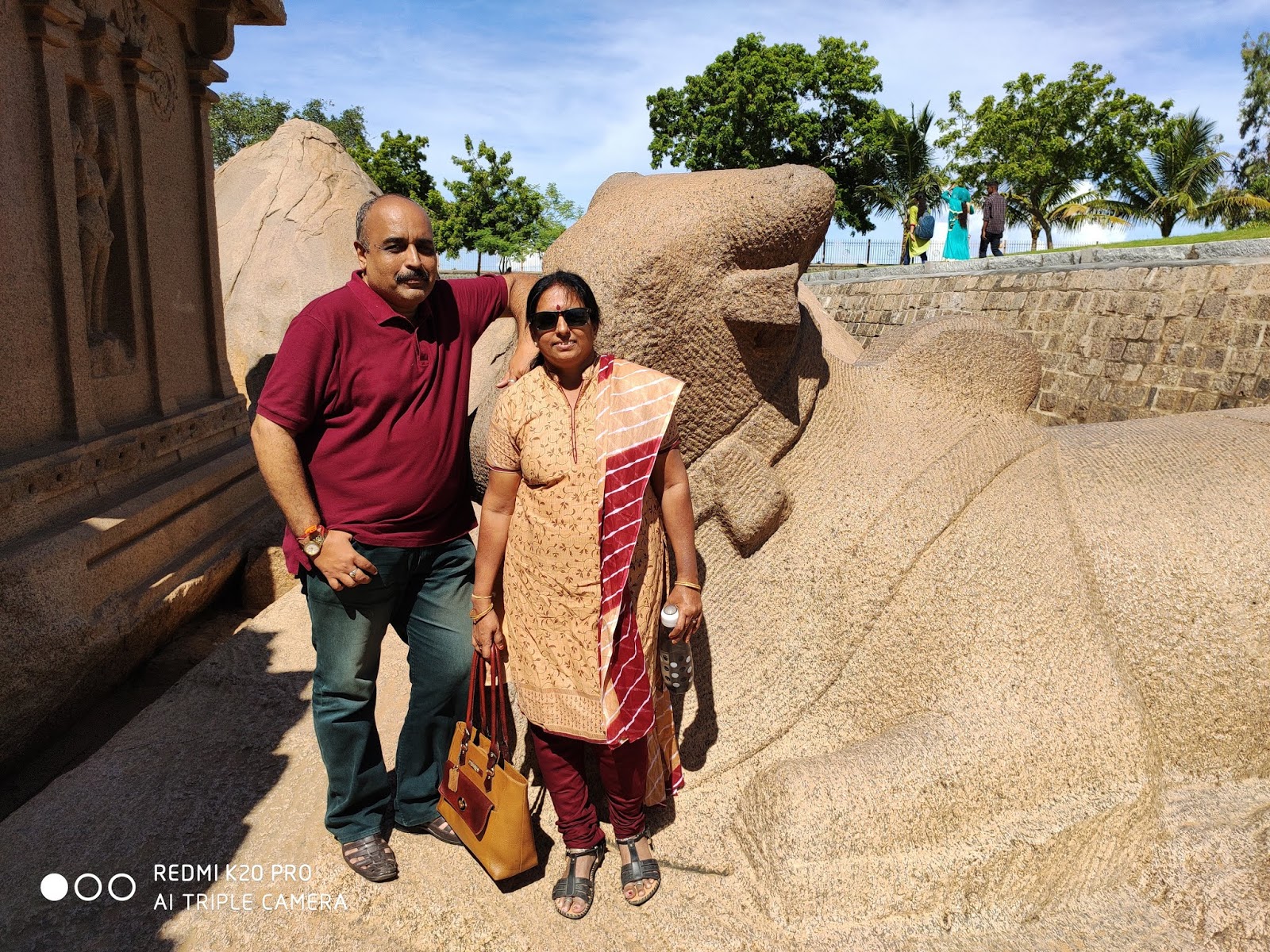
The first group of monuments we visited was the Pancha Rathas or Pandava Rathas (Ratha means Chariot) - a fine example of monolithic rock cut architecture. The five ratha styled temples are named Dharmaraja Ratha, Arjuna Ratha, Bhima Ratha, Nakula-Sahadeva Ratha & Draupadi Ratha. There are also life size sculptures of an elephant & a lion and a bull (Nandi).The Europeans referred to this as the seven pagodas based on the seven pinnacles atop the temples.This entire complex has been declared a World Heritage Site. Entrance fee per person is Rs.35.00
Revisiting these monuments after a gap of several decades. A memorable visit capped by some excellent pictures largely due a beast of a camera: Redme K20 Pro and a brand new selfie stick.
THE LIFE SIZE ELEPHANT SCULPTURE

NAKULA SAHADEVA RATHA
THE LION & DRAUPADI RATHA (L) ARJUNA RATHA(R)
DRAUPADI RATHA

THE BHIMA RATHA

THE DHARMARAJA RATHA

THE BHIMA RATHA

THE FOUR RATHAS FROM REAR:DHARMARAJA-BHIMA-ARJUNA-DURGA
BHIMA RATHAM


THE ARJUNA RATHA

Sekhar Upanayanam